
Number 37
A little girl wanders. A stranger steps in.

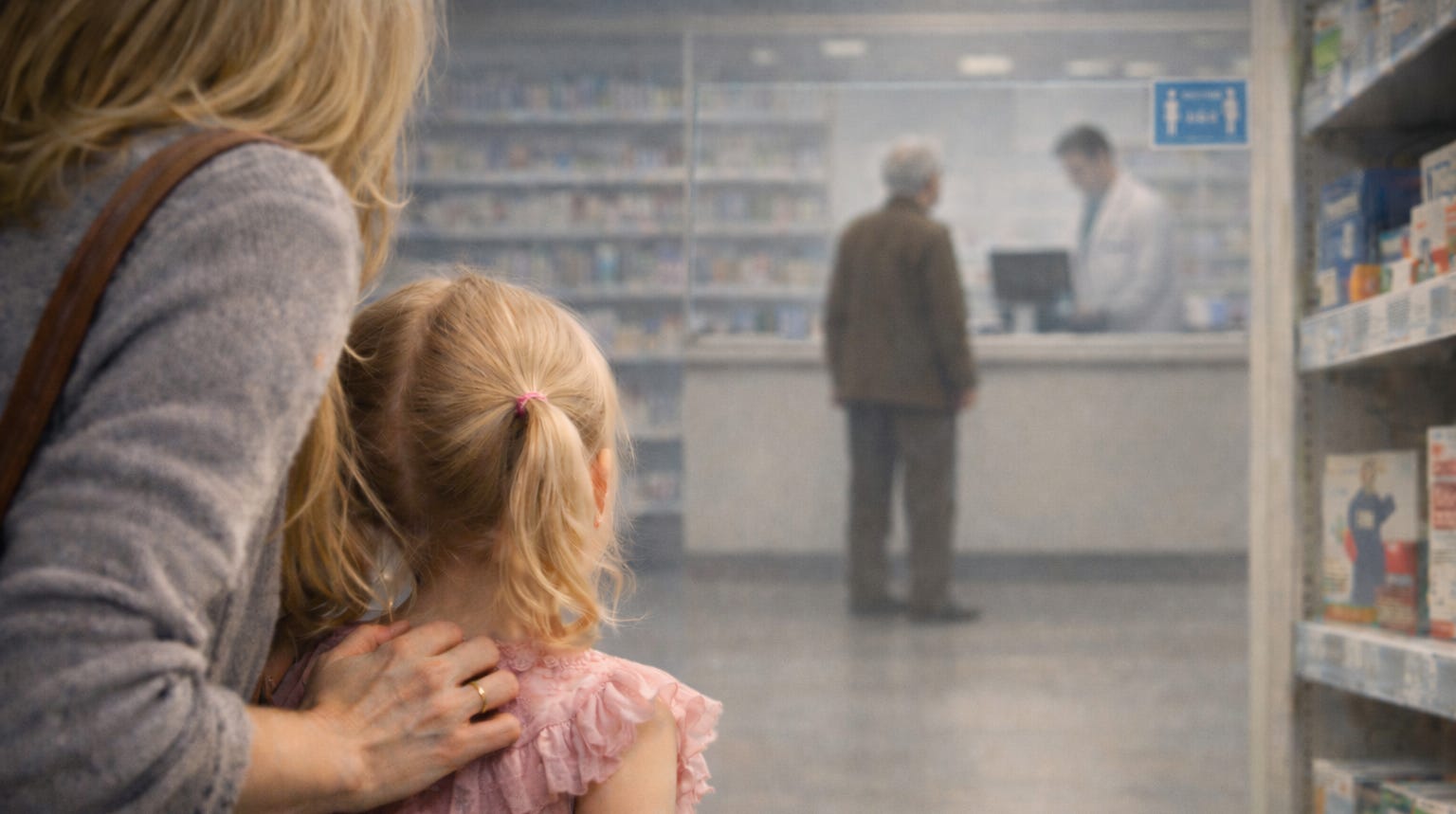
The little girl drifted slowly, attentive, hands ready to snatch anything that tickled her fancy.
A big plastic dinosaur was the obvious choice. A button on its back produced a loud metallic roar. Its jaw snapped too, making a clicking sound every time it reached halfway. The sharp teeth tickled her fingers, making her giggle.
When the Jurassic novelty faded, she stretched her hand and kept walking, touching items as she moved, almost knocking some onto the floor. Office supplies became hand creams and travel-sized shampoos. Then the bottles began, standing in neat rows.
Around the corner, the shelves suddenly changed.
Boxes with labels full of numbers and red warning stickers. Every box had the same gray man on it. On one he clutched his lower back, flames drawn behind him. On another he lay on a bed, a blue stream of Zs rising from his head.
She noticed a bottle with puppies on the label. She picked it up and spotted the colorful gummies inside. She tried to open it: pulling, twisting. Nothing. Then she tried her teeth.
A shadow fell across the shelf.
“Hey, hey,” a voice said.
The girl froze, mouth wrapped around the bottle cap.
An old man stepped into view from behind an endcap display. He raised one hand, palm out, like a crossing guard.
“Careful, young lady,” he said. “That’s dirty.”
The girl didn’t put the bottle back right away. She just stared.
The old man moved closer, his smile already in place. “You shouldn’t put your mouth there,” he said. “It’s dirty. You never know who touched it before you.”
The girl examined the bottle. “I wasn’t going to eat it,” she said.
The man nodded. “Smart girl,” he chuckled. “What’s your name?”
“Nina,” she said, puffing her chest, like she’d just figured out her coat buttons.
The old man leaned forward a little. He was close enough that she could smell him: clean soap, something powdery, a faint trace of mint. He tilted his head. “That’s a nice frilly dress, Nina.”
Nina flashed two rows of little square teeth. She grabbed the hems of her skirt and did a proud but clumsy twirl.
A rumble of steps on the opposite end of the aisle. A flustered woman turned the corner and paced toward the little girl. “Nina,” she said, loud but not yelling. “I told you to stay close.”
Before Nina could answer, the woman reached for her shoulder. Her grip was not too tight, nor overly gentle. It was the grip of someone trying to keep something important from flying with the wind.
The woman placed herself between the child and the old man. “Hi,” she said slightly out of breath. “Sorry. She wanders.”
The old man’s smile widened. He straightened up with some effort and patted the creases on his jacket flat. “Oh, no, no,” he said, sounding pleased to be talking to an adult. “No problem at all. She’s fine. She was just… she put a bottle in her mouth,” he said. “I just thought I’d say something. You know? Germs.” He made a funny face at the girl.
The mother kept a polite face. “Of course,” she said, her voice jumping up an octave. “Thank you.”
She looked at the girl, then back at the man. He was still there. “We’re just waiting for a prescription,” she added. “The pharmacist is getting it ready.”
The old man nodded vigorously. “Yes, yes. They’re very good here, very competent,” he said, gesturing toward the pharmacist’s counter.
His hand trembled. The mother’s eyes flicked to it. He shoved it into his pocket. “I come here every week for my pills,” he continued quickly. “My horse pills,” he winked at Nina.
The girl didn’t react.
“That’s good,” the mother said.
“Were you looking for something?” the old man asked.
The mother pressed a hand lightly on the girl’s shoulder. “We’re just killing time,” she said. “Come on, sweetie.”
“No, Mama,” Nina protested, raising a scraped knuckle. “I need a band-aid.”
“Oh,” the old man jumped in. “I know exactly where they are,” he said, giddy. “Come. I’ll take you.” He was already on the move.
The old man had just disappeared around the corner to the right before the mother had a chance to decline. She hesitated, then followed with Nina tucked to her left.
She caught the old man mid-sentence. “... they moved things around,” he said. “Since the leak.”
The mother’s hand stayed on the girl. “The leak?” she said.
The old man nodded eagerly. “Two days ago,” he said. “One of the pipes in the clinic upstairs leaked. I was there waiting for my bloodwork when Helen from the cash came up, bossing everyone around about the bathroom.”
He pointed at a brown stain on the ceiling. Looking up, he swayed and had to grab onto a shelf. A few boxes were knocked out of their neat rows.
The mother almost reached out, then stopped. Her grip on the girl loosened.
“Big mess,” the old man said, nudging the boxes back into line with the side of his hand. He moved through the store like a museum guide, ushering them past shampoo and cough syrup stacks. “They had to cordon off aisle three there. So they moved the band-aids…” He started to slow down. “Right…” He stopped, satisfied. “Here.” Behind him, a wall full of first-aid items.
The mother’s face softened, slightly amused.
The old man turned to the girl. “Now the question is what kind of band-aid do you want?” he said, eyebrows up, gesturing at the boxes with the cartoon characters.
The girl charged forward and started rummaging. She held one, two, four boxes close to her chest.
“My grandson loves dinosaur band-aids,” he said to the mother now. “I still have the box he left at my house last year when they came to visit. They live in California and almost nev…”
“Number 37?” called a voice from the pharmacist’s counter.
The girl came back running. “Here, Mama,” she said. “I want the kitty and the princess one.”
“Oh, that’s such a good choice,” the old man said, clapping his hands once.
“Mr… LeBlanc?” the voice called again.
The old man’s head snapped up. “Whoop, that’s me,” he said, sounding like he just won at bingo. He hustled to the counter, leaning on a wobbly display case along the way.
The mother and the girl followed at a slower pace.
The pharmacy counter was cut off from the aisle by a waist-high barrier and a scratched sheet of plexiglass, a faded social distancing sticker still clinging to the corner. Behind it, the pharmacist never looked up: scan, tap, bag, staple.
In front of the counter, Mr. LeBlanc stood straight, like he was waiting for roll call.
The mother and the little girl took a seat in the waiting area beside the counter. Nina stuck her arm into the blood pressure machine. The cuff whirred and slid down to her wrist. She tried the other arm, then both at once.
A few seconds later, the pharmacist pushed a small paper bag forward, just far enough to reach under the plexiglass. “Here you go, Mr. LeBlanc.”
Mr. LeBlanc leaned in. “Thank you, Dr. Miller. Thank you very much.”
The pharmacist nodded once, eyes on the screen. “Hold on, Mr. LeBlanc,” he said, tapping a pen against his chin. “I have you down for weekly pickup. We can do a month at a time, if you want.” He glanced up. “Saves you trips.”
Mr. LeBlanc laughed lightly. “Oh, no,” he said. “Weekly is fine. Gives me a chance to get out.”
The pharmacist didn’t smile. “Suit yourself, Mr. LeBlanc.”
Mr. LeBlanc tucked the bag into his breast pocket. He steadied himself on the counter and turned to go.
As he passed the waiting chairs, he lifted two trembling fingers in a small wave, already halfway gone.
“Thirty-eight?” the pharmacist called.
The mother looked down at the slip in her hand: 38, smudged at the edge. She glanced at Nina, then at Mr. LeBlanc. She stood, took Nina’s hand, and walked toward the pharmacist. But she didn’t stop. She kept going, past the counter, past the plexiglass, toward the man nearing the front door.
“Mr. LeBlanc,” she called.
He stopped and turned.
“I just wanted to thank you for the band-aids,” she said.
Mr. LeBlanc looked at the girl, then back at the mother. He pressed his lips into a smile. “Well,” he said. “That’s very nice.”
She continued, softer: “I’m Clara. And this is Nina.”
Nina waved.
“Please call me Peter.” He gave her a small nod.
Clara nodded back. “We’ll see you around.”
Peter kept walking.
The automatic doors opened with a soft hiss. A gust of cold air swept in.
“Bye, Helen,” he called, waving at the cashier thumbing through lottery slips.
Helen didn’t look up.
The doors closed behind Peter with a soft thud.
Gripping writing, Man in Plaid!
Simply lovely. These simple ordinary acts of kindness and expressions community are so important and much needed today. I fear we are becoming a culture of Eleanore Rigby’s. Thank you. Blessings, Mark